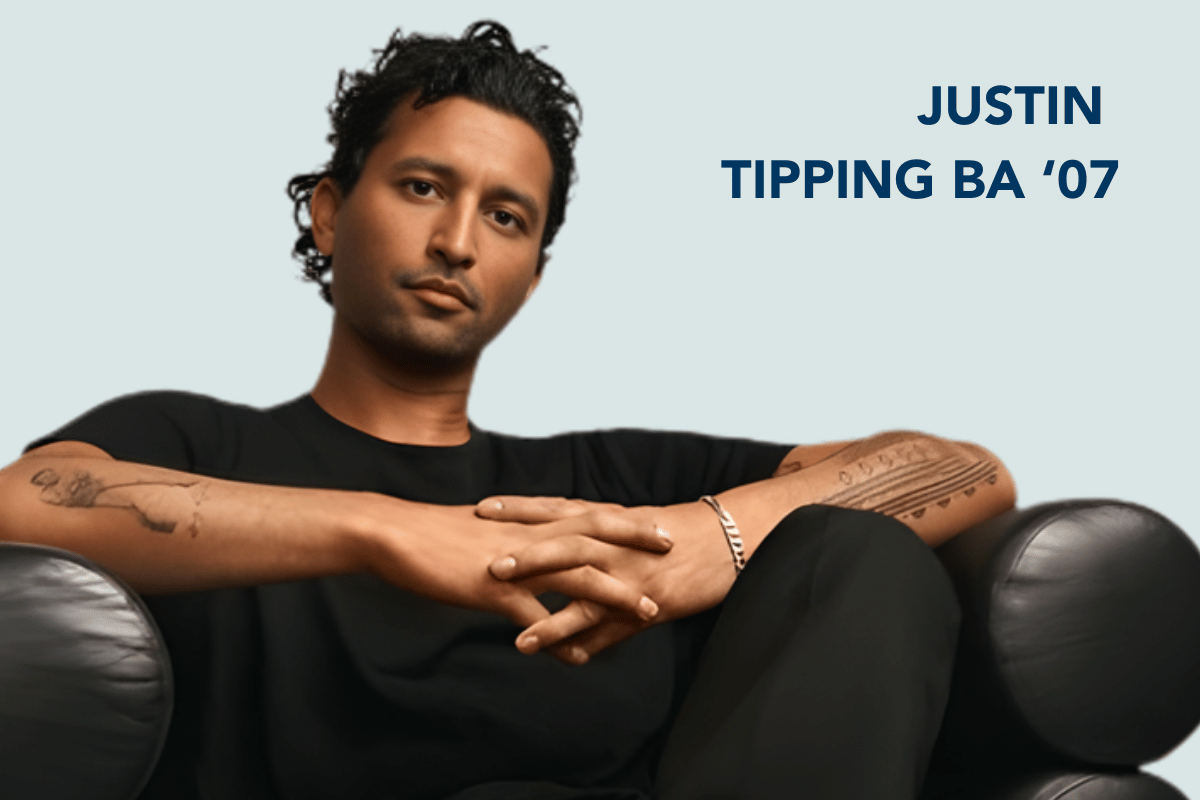
In this Alumni Spotlight Q&A, Justin Tipping reflects on the path that led him from UC Santa Barbara to a career in film and television directing. After discovering his passion for cinema through UCSB’s film theory curriculum and a formative study-abroad semester in Italy, Justin built his career from the ground up: working freelance jobs, learning on set, and eventually earning his M.F.A. from the American Film Institute. He shares how his academic foundation at UCSB shaped his creative voice, the personal experiences that influence his storytelling, and the journey that led to his recent feature film HIM. Now an award-winning director developing new projects in both TV and film, Justin looks back on his UCSB roots as the place where his curiosity, discipline, and love for storytelling first took shape.
You earned your B.A. in Film and Media Studies. What drew you to that major?
I came in studying Business Economics, and then I started failing immediately. But I think I had just randomly taken Intro to Film as an elective, and I think that's when the seed was planted. Ultimately, I didn't actually officially declare until the end of my sophomore year after studying abroad in Italy for a semester. I did an exchange program at John Cabot, where I took Italian Cinema and some other art classes. It was the combination of all those courses that made me realize how much of an impact the medium has on society and culture. That's what really drew me in. In the beginning, it was simply something I wanted to learn more about.
Were there any classes or professors at UCSB that influenced the way you think about filmmaking or creativity in general?
Honestly, all of them. I’m so happy and grateful that I had a theory background in film instead of studying production. I think many young students worry about things like, “I don’t know how to operate a camera,” but the reality is that anyone can learn—you just need to be on a set. Most of my success I attribute to the core foundation of the curriculum at Santa Barbara.
I don’t think she’s there anymore, but I remember Janet Walker was a professor when I was there, and she had a big impact on me. She taught documentary and semi-autobiographical documentaries. I loved all my classes, but I think my favorite was the 192 series, which focused on theory and framework. The 192 series was rooted in cultural and critical analysis, and then there was a part of the 101 series where we studied New Wave Film Cinemas. So Post-World War II era. That introduced me to most of the films that I love and am inspired by.
Can you walk me through your path after graduating? What were the key steps that led you into directing professionally?
So I actually moved back home because I couldn’t afford to live anywhere else. My first job was at a temp agency, and I started packaging coffee beans on a factory line. The struggle was real. I was trying to freelance in videography in any capacity: editing, shooting, whatever I could find. I saved up money and then moved to Los Angeles with some other friends from UCSB who had a room and a bed available. I went with my car, a suitcase and a dream, because I didn’t know anyone in the industry. It was pretty scary.
Once I got to Los Angeles, I quickly found groups of young people who were also trying to make it. I worked for free or interned, whatever I could find. If I could be a PA on a set, I took it. And when I wasn’t trying to be on set in any capacity, I was making things. A group of us were taking turns directing, taking turns being cinematographers and taking turns producing each other’s short films and music videos.
And a couple years of that led me to grad school and I happened to get into the American Film Institute for directing. I got my Master’s in directing from the American Film Institute, and that’s what officially launched my career. I won a Student Academy Award, went to several festivals, and from there I got representation: an agent, a manager, all the things required to be a professional director in the world. That was the beginning of my career. But it’s always a struggle. It’s definitely difficult to have a career as a director.
HIM tackles intense emotional and psychological themes. What initially drew you to this story?
What initially drew me to the story was that I was in a place in life where I was actually burnt out from shooting so much television. The schedules and hours were crazy, and it was post-COVID. I had shot through the entire pandemic, which was a really bizarre experience. I remember being in Australia and missing things like my brother’s wedding, the birth of a nephew, and one of my best friend’s weddings. I felt stuck and kind of trapped. When I got back, completely burnt out, I remember receiving the script.
Although the core of the story centers around the psychology of “What does it take to be the greatest of all time at what you do?”, I could relate to it through film. And I think a lot of people can relate to the question: “But at what cost?” Especially in our hustle culture, grind culture, exhaustion economy, and within capitalism at large. I thought it was a great opportunity to explore those themes.
It became even more interesting when I realized that the history of the game itself was rooted in military and American war. It was a combination of all those elements. I also played club soccer at Santa Barbara and was an athlete before giving up that goal, so I understood the athlete’s perspective—the machismo, the hazing and the absurdity of masculinity that surrounds a lot of sports or fraternal worlds.
So being able to tackle those thematically within a movie—one where I couldn’t really point to another film that had mashed up those two genres in that way—was exciting. It was really an American sports genre and a horror genre. So as a film studies major, I was most excited about the opportunity to tackle something like that.
What does your creative process look like when developing a new project? From concept to final cut?
This one was slightly different because I inherited a script and then I did the rewrites to it. But my first feature was from an original idea that I did on spec, which is when you just write something for free as an example, but then ultimately I got to make it. The process from conception to screen is a very long time in film, and each iteration of the story—and what you think it is in your head—changes.
So conception begins, and the writing process begins with a lot of crying and tears and frustration and long walks. And then, finally, you get to a draft that is a great story. The second phase, I think, is reconciling what’s actually possible. Most often, it’s like, “Yeah, that would be amazing, but there’s no money,” or you have to figure out time and a million other factors. So that’s the next stage of production, which is problem-solving and pivoting and improvising and trying to tell the same story without giving up too much.
And then the edit process is very similar to writing. They say it's the last step of writing because you're now left with this footage, and usually it doesn’t match what was in your head either. Now you’re trying to approach that and deliver it. It’s like raising a kid in a way, where you spend years of your life trying to get this thing made, and then it just goes off into the world and all you can do is hope for the best and hope it finds people. If one person loves it, then it's worth it.
To sum it all up, my process through all those stages of filmmaking is more like a sculptor—trying not to approach something as if I'm creating it from nothing, but as if I'm just uncovering the thing. And that helps a lot and takes the pressure off.
How do your personal experiences influence the stories you choose to tell?
Everything that I touch, I definitely find myself bringing—naturally or subconsciously—something from my own personal experience. And I think authenticity changes, and it's elastic, so things I didn’t think I would want to tell 10 years ago are things I’m now really interested in. It’s more about, “Oh, this is a fascinating genre,” or “This could be a great story,” but then asking, “What’s my personal connection to it?” Because you spend so long on these projects, and unless it’s something that resonates, I have to have that too.
For Kicks, the emotional impetus was definitely inspired by the time I got jumped over a pair of shoes and could no longer go to my grandma’s house because that area got active. And, you know, uncles and cousins were affiliated, so it is very personal to people in my life, but it’s drawn from my own observations and experiences.
And even with HIM, ultimately it really centers around the protagonist who’s dealing with the death of his father, and that was also my story. There’s a monologue in that movie where he’s talking about his father’s sudden passing. A version of that did happen to me a couple of years before I made this movie, and I was still working through that traumatic event—where you suddenly get a call that your father’s dead—and I was on a film set when that happened. So it’s all intertwined.
I would say that if there’s something in me that feels inspiring, then I’m looking for ways to bring some humanity to it.
Was there a specific scene in HIM that was particularly challenging or meaningful to direct? What made it stand out?
Well, I guess we just talked about it. When he has this media day and is talking to the press, and he’s telling a story about his father. It was an emotional day on set, and talking to Tyriq about my experiences—and Tyriq had also recently experienced the loss of his brother—so we were, in a way, both kind of healing through our own trauma in that scene.
Also having the audacity to just frame it as the Last Supper—everyone was very worried and nervous, like, “I can’t believe we’re actually doing this.” But it was a really amazing moment on set when the cinematographer and everyone were so excited. Everyone was excited about pulling it off. And then on top of it being exciting from a technical standpoint, there was this emotional payoff and a reminder of the real reason we share stories.
What advice would you give current UCSB students who want to work in film or television?
My advice would be to go fall in love, fall out of love, be broke, make money, spend it, get into some trouble—but safely. Don’t think that you have to do anything specific to work in the industry. The reality is that film school worked for me; it doesn’t work for other people. There really isn’t a “right” way in, other than you just have to create.
So, yeah, I would say: live life. Because you can’t create anything, and you have no stories to tell, unless you have experiences. That’s what I would say.
What’s next for you? Are there upcoming projects you’re excited about?
Yeah, I am writing the next projects right now. I can’t speak about them, but I will be back in both the television and feature film space. So hopefully I’m back at UCSB screening another one!
Visit our alumni spotlights page for more alumni spotlights