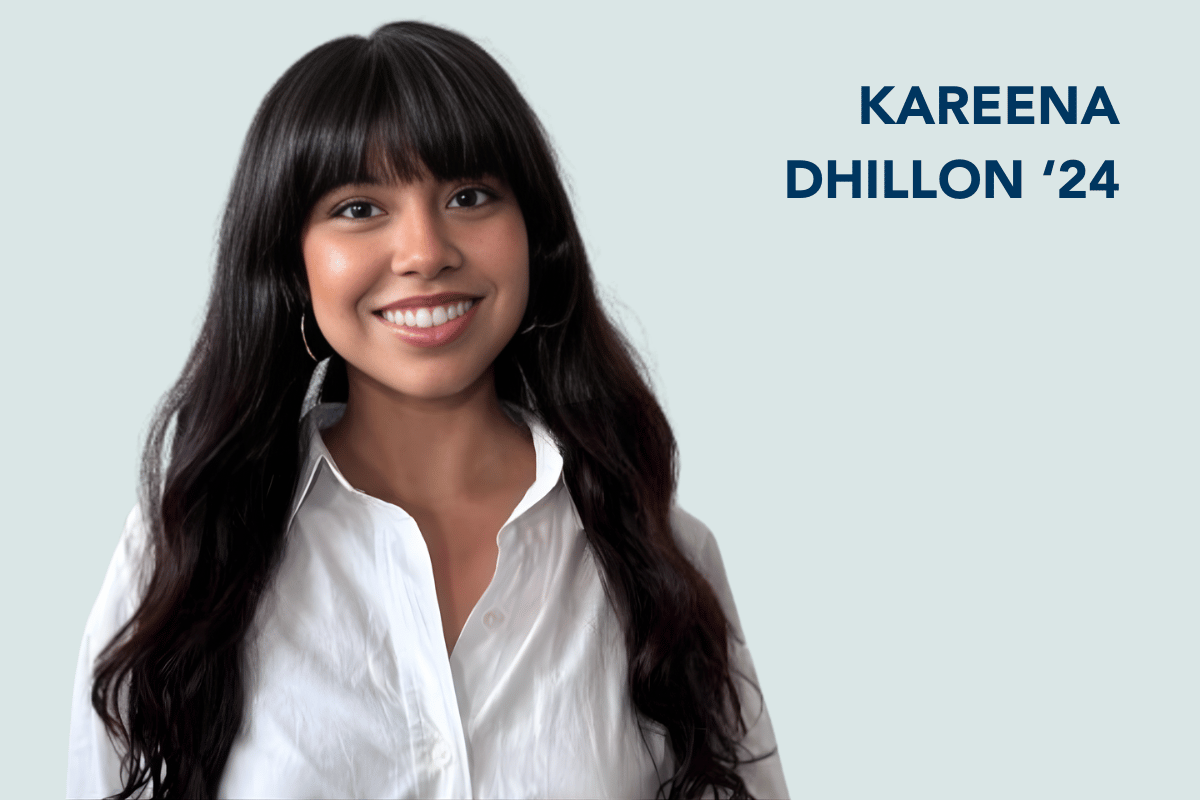
In this Alumni Spotlight Q&A, Kareena Dhillon reflects on how her time at UC Santa Barbara shaped her path into community-centered nonprofit and policy work. From studying global systems and languages to creating safe spaces on campus and engaging directly with local youth advocacy organizations, Kareena traces how her UCSB experiences laid the groundwork for a career rooted in empathy, collaboration, and civic engagement. She shares how those early lessons led her to leadership roles in human rights and international advocacy, the importance of bridging local and global action, and why she believes every individual has the capacity to make an impact. Now working across nonprofit, policy, and international spaces, Kareena looks back on UCSB as the place where her commitment to service, equity, and community first took shape.
You earned your B.A. in Global Studies. What drew you to that major?
I really loved the emphasis on intersectional history and language. I had tremendous professors who really focused on bringing a global approach to how we understood history. And then I was also able to fully immerse myself in languages, so I studied Arabic for two and a half years and then Russian for a year.
You served on the executive board for the Wellness Project. What motivated you to join that organization, and how did creating safe spaces on campus shape your sense of purpose?
For me, I saw the value of community to be really important for anyone trying to find their place and feel belonging. And the Wellness Project worked hard to curate, foster, and grow that community. So it was a great experience to see it from its inception to what it became.
I want to emphasize that the women I worked with at the Wellness Project were incredible individuals, and it was a privilege to get to know people across communities at UCSB and work together at such a precarious time. It was 2021, and I felt like what we were doing was really important.
In Alpha Phi, you served as Vice President of Diversity, Equity & Inclusion. How did that leadership role shape the way you approach conversations around representation, inclusion, and community building?
It really pushed me to do my research to educate myself and be able to communicate certain nuances when I led programming. At the time we had about 230 women in our chapter.
So it challenged me to think about how I wanted to lead, and to think about what made a good, responsible leader. It also allowed me to envision and carry out different ways of community building, whether that was through events or programming. So it was a great experience in that it encouraged me to grow and be better.
You mentioned that being of Asian descent, UCSB felt like a diverse space where you could use your voice. How did your identity shape your experience at UCSB, and how does it continue to inform the work you do today?
Yeah, definitely. I loved UCSB because I really felt like I could embrace certain aspects of my culture and heritage that I wasn’t able to before. So it was really nice to feel that I could represent myself and identify with those parts of myself.
The way this continues to inform my work today is by reinforcing how essential it is to center diverse and historically marginalized voices. Listening to people of color––their perspectives, experiences, and contributions––is critical to meaningful and effective work. This is something I actively prioritize across my professional work. Through my work with WCAPS, I write op-eds and conduct research that elevates these voices. It’s a commitment I carry into all areas of my work.
Was there a specific moment or experience that made you realize you wanted to dedicate yourself to service and civic engagement?
Community-based work is deeply important to me, especially those moments when people come together to create something meaningful. Even amid busy schedules and competing demands, choosing to show up—for an event, for one another, for a shared purpose—is incredibly powerful and personally meaningful to me.
Also, being at different conferences at the United Nations headquarters in New York City is incredibly powerful. To be in spaces with people from all over the world who are also overcoming adversity to be there, to make sure that their voices are heard is inspiring. Being in those spaces really inspired me to continue the work that I do, despite the obstacles that I encounter.
You’ve held global-facing roles with Young Professionals in Foreign Policy (YPFP), WCAPS, Rotary International, YOUNGO, and UNA-USA. What inspired you to expand your work from local service to international peace, security, and climate justice?
I think one thing that I try to incorporate in the work that I do is trying to make it clear that there are so many overlapping aspects from the global to the local. I like to work in my community because I really do think that the global does enforce and impact the local, and the local also shapes the global.
So I try to do both, and it’s really nice because working in Southern California is a community that I’m very passionate about, but then I can also work with UN officials and people all over the world virtually, because climate change also impacts every single person on this planet. And it’s nice to be able to envision that and make progress toward helping disadvantaged communities while also bringing climate literacy and advocacy to different communities and organizations.
Civic participation is something you’ve highlighted as especially important today. From your perspective, what barriers do people often face when trying to get involved?
I think people can often feel that they don’t have a voice or that what they do won’t make a difference because climate change is so daunting. But truly every single person can make a difference.
So really leaning on knowledge-sharing community networks to kind of get in the door is huge, because once you’re in, it’s a lot easier to move through. But every single person can have an impact, and I’d encourage everyone to do their own research and look for those resources. But it definitely is difficult to access that capacity and get started in the beginning.
Follow up: How can communities empower individuals to believe that “anyone can make a difference”?
I like this question because I think communities are cyclical entities that really nourish and help people grow and realize their own potential. So I would say it’s interesting to think of it this way, but I’d encourage anyone to pursue what they’re passionate about, and in that, they will find a community that they resonate with, that will lift them up and inspire them—whether your interest lies in human rights, marine health and safety, education, or advocacy.
What I found in my own experience is that you will uncover communities that will allow you to envision the ways that you can contribute to your community, that you can make a career out of this, and that you can continue to make an impact.
What advice would you give to students who want to support nonprofits or engage civically but don’t know where to start?
This is a question that I would ask my mentors and people that I looked up to for years, and it’s a question that I still ask midcareer and senior-career individuals. And something that they taught me is to find something you’re passionate about—because I think we all have causes that we already support and think about—and find ways to get involved. I think that’s a great first step.
I’m constantly inspired by how much we want to help one another and the kind of resources that are available. You might have to dig a little bit, but the resources and the structures are there. I’d encourage those looking to get involved to seek out their local United Nations Association chapter. I believe there are over 200 across the country.
But also look into youth centers, mutual aid organizations, conservation groups, libraries, and clinics. And see how it grows from there, because I really think that we all have things that we’re passionate about, and it just takes that first event, that first meetup, for it to take root.
I want everyone to know that they have an impact. Every voice has an impact, and it only takes one idea to build or create something that you’d like to see. And it starts with building community and creating safe spaces.
Visit our alumni stories page for more alumni spotlights