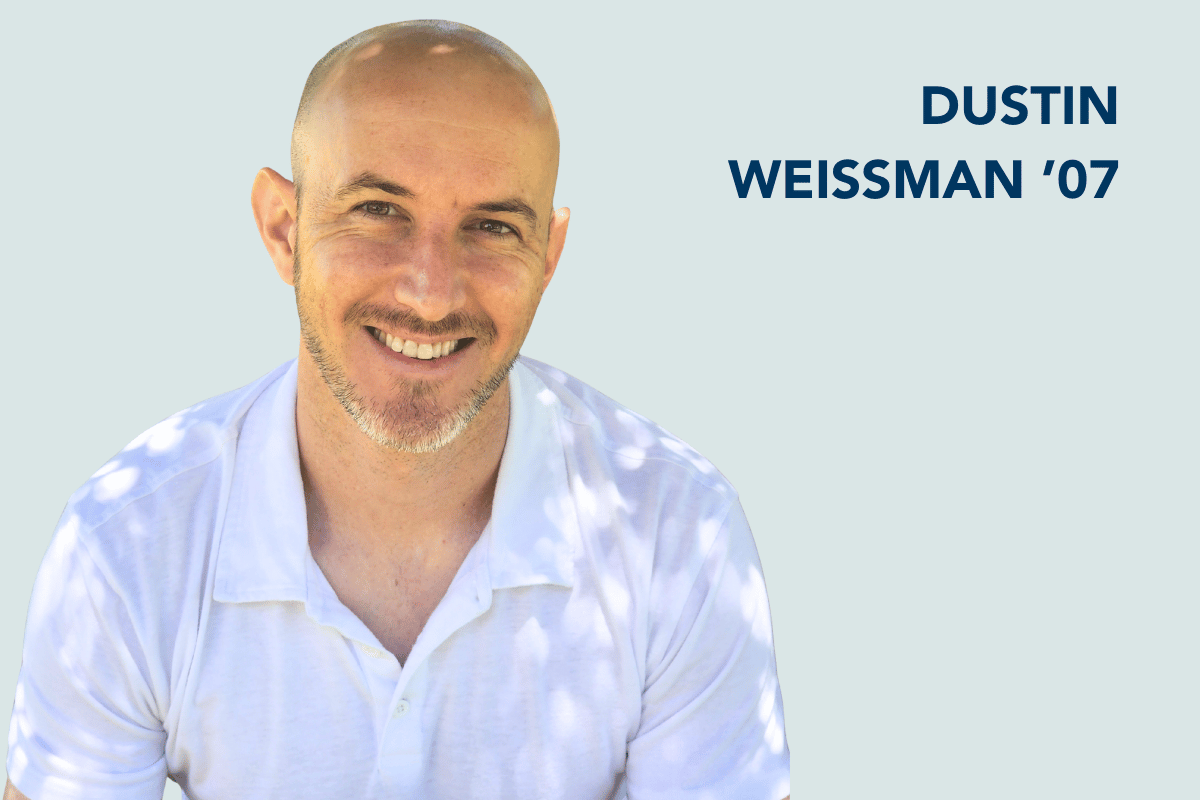
In this Alumni Spotlight Q&A, Dustin Weissman, PsyD reflects on the experiences that led him from UC Santa Barbara to a career in clinical psychology and professional leadership. He shares how formative experiences at UCSB, from working in psychiatric and developmental disability settings to developing confidence as a speaker, shaped his professional path. Dr. Weissman also discusses his graduate research on online role-playing games and social interaction, conducted at a time when digital psychology was still emerging, and how that work grew into a long-term focus on technology use and mental health. Now serving as President of the California Psychological Association and presenting nationally on topics like video game addiction, Dr. Weissman looks back on UCSB as the place where his commitment to psychology, leadership, and community first took root.
You entered UCSB undeclared and later declared Psychology during your fall quarter. What ultimately drew you to the major?
I was a founder of my peer support team in high school, so I already had an interest in psychology. I did the Freshman Summer Start Program (FSSP), the summer before freshman year began. I had Psychology 1 with Professor Fridlund and I loved everything about it. That fall, I declared psychology as a major.
You were involved in a wide range of activities, from Alpha Epsilon Pi leadership roles to intramural soccer. How did those experiences help you build skills like organization, leadership, or collaboration?
I definitely learned a lot while being on the executive board for Alpha Epsilon Pi. I was the rush chairman for three terms, and I broke our rush record and then rebroke it again. I think I recruited over 80 members during that time, and we were over 100 when I left. A lot of planning, organization, communication, and leadership skills went into that process. I believe it really me to develop and hone those skills.
Your internships and early work experiences were especially hands-on, including working at a psychiatric center and later supporting adults with developmental disabilities. How did those roles influence your understanding of mental health and your future goals?
I had two prominent training opportunities as an undergrad at UCSB. One was at Sanctuary Psychiatric Center. That was my first experience working with people who were mentally ill. I remember day one: I walked in, and one resident came down, sat on the couch, and started talking to himself. That was my first experience with schizophrenia. I felt like I should have been put off by it, but it just seemed right. I had really good experiences working with the people there who were struggling with their mental health issues, and it fortified my interest in psychology.
It’s one thing to learn about it in a book or see videos, but to work hands-on with people who struggle with mental illness, especially more severe issues where they lose touch with reality, was fascinating to me. It really helped me realize that, yeah, this is something I want to do.
The other experience was working with two men who were developmentally delayed and had intellectual disabilities. I provided in-home support services for them, helping take care of some of their more basic daily needs and just engaging with them.
You’ve described UCSB as a place that teaches students to “work hard and play hard.” How did that balance of academics and social life shape your college experience?
The great thing about UCSB is there’s always a party. It really helps with addressing fear of missing out (FOMO). If there’s always something happening, you’re bound to end up missing something. And when you’re ready to celebrate, let off some steam, or engage in recreational activities, there’s always an opportunity at UCSB. Because of that, you don’t have to go to everything.
If you have to study, then you study. If you have a midterm or a final on Tuesday, you can go out that night, you don’t have to go out on Monday. Because of that, there’s less pressure to get to everything.
I feel like at some smaller schools, there are fewer social activities and fewer parties, so you feel like you have to go to the one thing happening. But in Santa Barbara, that’s not the case. I think that helped my balance; when I had to get stuff done, I got it done. I always had the mentality that if I’m a student, this is my career and this is my job while I’m at UCSB.
The other jobs I took on were typically in the summer. The residential treatment center job was in the fall, but for the most part, I always prioritized school and academics. I’m aware that financially I was fortunate and didn’t have to work a job to put myself through college. That changed when I was in graduate school, I worked as a tutor and paid for a lot of my own things, along with student loans.
Your graduate research focused on online role-playing games and social interaction at a time when that topic wasn’t widely studied. What drew you to that area, and what made it such a unique moment to be doing that research?
I always loved social psychology. I remember I took numerous social psychology classes while at UCSB, and I wanted to do my dissertation somewhere in that related field. We had a book called Pocket Guide to Dissertations, and I remember reading some dissertation titles and one mentioned Camelot. That allowed me to think a little outside the box, that I didn’t have to do boring, stuffy psychology research on social psychology. It could be something a little more fantasy-oriented or outside the box in that regard.
This was also when World of Warcraft was becoming a big game. I tried it out, but I only ever played the trial, I never paid for the subscription. I realized this was something worth looking into. One of my neighbors at the time was playing it all the time, and I was just curious. As I started researching it, there wasn’t much existing research. New research was being published as I was learning about it, so I was kind of riding that wave as it developed. It was definitely very timely.
There was one book that Dr. Kimberly Young, who’s considered the mother of internet addiction, had written called Caught in the Net, which focused on AOL chat rooms. She recognized there was an issue in the allure of the internet and online community. So I started researching it, continued down that path, and it ended up becoming a very large part of my career.
You’re now stepping in as President for the California Psychological Association. What motivated you to take on that responsibility, and what challenges are you most focused on addressing?
I think it was my very first convention that I attended for the California Psychological Association in 2018. I remember that Dr. Paul Marcille was the president at the time, and the convention theme had a focused track, Psychology in the Digital Age. Dr. Jean Twenge was one of the keynote speakers, and I was sitting next to her at the table before she went up. I got to have a nice conversation with her. She wrote the book iGen, and she also has a newer book that came out addressing parenting, teens, and screens.
At that convention, I knew I had found a professional home. Interacting with Dr. Marcille, and over the years with other presidents like Dr. Robert Buonfiglio and David Lin, I knew that one day I would be one of those presidents. It’s kind of in my blood, too. My father is an attorney, and he was president of the San Fernando Valley Bar Association, so I guess I aimed a little higher.
I’ve always been fond of leadership positions, so it felt natural that I found my way into wanting to be a leader of the organization. I told myself I would be president one day. I didn’t know when, but I did tell myself, “I’m going to be president of this organization one day.” I wanted that for myself. And now, here I am today.
Last month, you spoke at the Evolution of Psychotherapy conference. This is one of the most prestigious stages in the field of psychology. What did that moment mean to you, and how did it feel to share your work at that level?
Yeah, so this one kind of snuck up on me. Knowing that I was going to be president of the California Psychological Association, I reached out to different organizations that run conferences. One of those, which I didn’t realize at the time, was the same group that runs the Evolution of Psychotherapy conference. So it really felt like the stars were aligning. It wasn’t even on my radar yet.
In my mind, the speakers at this conference are the people who come up with different therapeutic approaches to psychotherapy. They’re the top people—the ones who write the books we study in graduate school. So I didn’t expect myself to be at that level. I’m still on cloud nine, having been selected and now having presented there, realizing that I am at that level.
And it wasn’t just that I gave a presentation—both sessions were very well attended, and they went really well. I spoke on video game addiction. The first presentation focused more on the lures and the draw of why people play, and the second was on the treatment of video game addiction. I received a lot of great feedback, and I’m still kind of reeling from how well it went.
You’ve spoken about the importance of community within professional spaces. How do you think leadership can help foster connection and engagement?
I had a professor at UCSB who told me, “Find something for your career that you would do even if money wasn’t an object. Find something you’d love doing.” And I found that. I think that’s the first step: finding a career you genuinely love, where even if no one were paying you, this is how you’d choose to spend your time.
Second to that is community. Maslow’s hierarchy of needs includes social belonging, and having workplace communities is extremely important for fulfilling those needs. Whatever you’re going to do in life, whether you’re an attorney, an accountant, a doctor, a garbageman or a landscaper, find your professional community. Go to whatever organization exists for you. If there isn’t one, make one. I just find it helpful to feel like you belong and to find people who get you. It’s extremely important in that regard.
I think leadership definitely puts you in a position to get to know your colleagues in your organization and what’s important to them. As I stepped into leadership roles, I learned about advocacy. I had never done any advocacy prior to getting involved. I went to Sacramento last year, and I’ll be going again this year, lobbying for different bills that protect both psychologists and the community, depending on the bill.
We had two bills last year that focused on AI. One passed and is now law: AI chatbots cannot misrepresent themselves as therapists, which is mainly to protect patients. There have been numerous deaths involving people talking to AI without receiving proper care. The other bill focused on protecting confidentiality. The Board of Psychology wanted to make changes during the Sunset Review, and we blocked one change that would have made it easier for them to access patient records.
Looking back, how do you see your experiences at UCSB continuing to shape the work you do today?
I learned a lot at UC Santa Barbara. It’s funny I was just thinking about this and wondering how much Dramatic Arts 5, Intro to Acting, played a role in me being comfortable in front of people. I was already fairly comfortable speaking in front of others, and I had been involved in my youth group and leadership positions there as well. But I think Dramatic Arts 5 was definitely a class that helped me feel comfortable stepping outside my shell.
For example, at the Evolution of Psychotherapy Conference, in my first talk, I came out wearing a Harry Potter robe. You’ve got to be pretty bold to wear that in front of professionals. It was very well received. It was like, this guy could be a complete nerd, or it’s kind of cool. And I think it was both.
I also think certain psychology classes I took, PSYCH 1 for sure, continued me on my trajectory toward becoming a psychologist. Some of my social psychology classes with Professor Klein did as well. I believe SOC 152A is taught by the Baldwins, if they’re still around. They’ve been teaching human sexuality forever, and I think it was that comfort level they had being in front of such a large classroom that stood out to me.
Overall, I believe my experiences at UC Santa Barbara definitely continued to develop me in the right way to become the professional I am today.
What advice would you give current UCSB students who are interested in psychology or leadership roles but aren’t sure where to start?
Okay, so let’s separate those. If you’re interested in psychology, I highly encourage you to talk to professionals. Actually, I think that works for anybody—talk to professionals in the field you’re interested in, people who have already crossed that finish line. There’s so much you don’t know that you need to do.
With psychology, there are certain things, like the importance of an APA-accredited internship if you want to work in certain areas. If you want to work in anything government-related, you need an APA-accredited or approved university. I didn’t go to an APA-accredited university. I went to Antioch University in downtown Santa Barbara. I had great professors, but the program didn’t have APA accreditation, so I can’t ever work for the government, which is fine for what I’m doing in my career. That’s why it’s really important to ask those questions, because you don’t know what you don’t know.
That’s the question I’d tell students to ask a professional: “What do you know that I don’t, but should?” When I was graduating from undergrad, I sought advice from probably the most successful person I knew, and he told me, “Get more education.” It was as simple as that. This was in 2007, and he was in real estate, right before the market went bad. He knew, because I was considering getting into real estate and was kind of going to him for a job. I wanted to be as successful as I could be. But instead, I went to get more education, and I had already started the process of grad school.
If your profession requires graduate school, figure out what level you need. For psychology, that’s the master’s or doctoral level. If you just want to be a therapist, maybe a master’s is enough. But if there are certain things you want to do, like teaching, research or testing, you need a doctorate. Figuring that out is really important. I recommend this to my patients, too, when I’m working on life transition issues: talk to someone who’s already successful in the field you want to be in and get their advice. They may also help you make connections.
As for leadership, if you want to be in leadership roles but aren’t sure where to start, I’d say get involved in committees. If you’ve never done any leadership before, get involved on boards. There’s always lower-level work you can do to see how organizations operate. I can tell you for a fact, especially in psychology, leadership roles are needed. We need leaders. There are more opportunities than there are people willing to step into them.
I see this across California. Many regional associations, like the Santa Barbara Psychological Association or the Ventura County Psychological Association, struggle to get people to volunteer their time. But it’s incredibly rewarding. You get a lot back. There are opportunities to network on a more personal level because you’re meeting regularly with the same group of people. I know that by being involved in committees and boards, I’ve gotten many referrals for business and for patients.
Beyond that, it’s just really meaningful to give back. I find that with any organization, the more you put into it, the more you get out of it. I’m obviously putting a lot into the California Psychological Association, and I’m also getting a lot out of it.
Visit our alumni stories page for more alumni spotlights